Tuesday, July 16, 2013

Eating Vegan in Korea and Japan

One of the things many people have asked about our trip to Korea and Japan last month is how did I maintain a vegan diet while we were there. Those countries are heavily reliant on seafood, and even in dishes that are not inherently meat-based, some kind of fish sauce is often used in the preparation.

When planning the trip, the details of how I was going to eat were something that gave me a certain amount of anxiety. Even if vegan-friendly dishes are on the menu, the language barrier would make it difficult to ask the wait staff (if there is any) about them. Some people have blogged about how to travel and stick with a strict vegan diet. That's not what I'm doing here. Before we left home, I decided that the best way to approach the situation was to just do the best I can with it.

Fresh vegetables are easy to find in Korea.
While staying at my sister's house in Korea, things weren't so difficult. For meals that were prepared at home, we generally knew what was going into them. But that wasn't always the case. At one of the open-air markets we went to, I bought a few different items from a kimchi stand. When we served them with dinner that night, I found that one of the big piles of seaweed on my plate was saturated with fish oil. I ate it anyway. It freaked me out a little, but I figured that as long as it was there, I may as well have the culinary experience.

Udon!
The scenario would repeat itself to lesser degrees at various restaurants - the udon might be prepared in fish stock; the baked goods may or may not contain dairy or eggs; the rice and vegetable dish might have shredded dried fish as a garnish. I decided that I wasn't going to let that be too much of a hang-up.

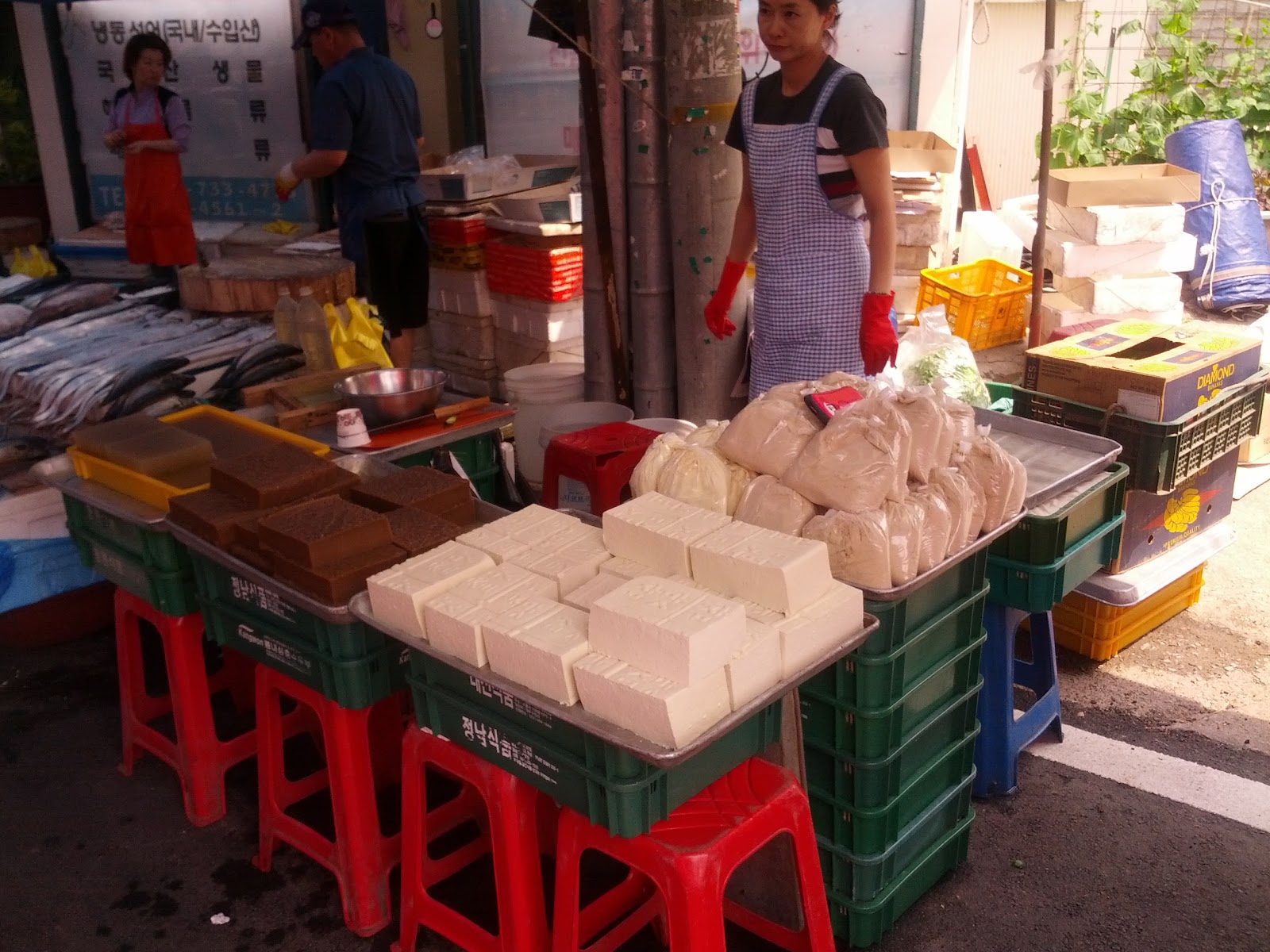
Tofu and bean curd vendor in Pyeongtaek
So did I "cheat" on my diet? I wouldn't say so. When people talk about cheating, I imagine it to mean that there's some forbidden thing they just couldn't find the willpower to resist. But in foreign countries, there are some food dishes that are just intrinsic to the culture. I'm not sure it counts as cheating to make a calculated decision to experience that aspect of the journey despite the fact that it doesn't hold up to the standards we would keep while at home. And the classic definition of veganism allows that the best we can do is make every reasonable effort to avoid the exploitation of animals. It doesn't say anything about having your super-powers revoked just because you can't speak the local language.

Anyway, the short of it is: I didn't want to turn the family vacation into a frustrating exercise in foraging for food in a land where the notion of veganism is as foreign to them as their traditions are to me.

Ad for a Vegan phone (yeah, I know...)
That said, I think it went pretty well. We managed to find soy milk at the 7&I convenience stores (7-11 equivalent, to those here in the US).

Japanese soy milk - the picture of the beans is a give-away, but also look for "大豆" (soy) or "豆乳" (soy milk)
They also had steamed rice and seaweed with sesame oil in the refrigerated prepared foods section. At grocery stores we found everything from fresh produce to breakfast cereal to eat in our hotel room that were known to be vegan. When eating out, there were always tofu and vegetable dishes that appeared to be fish-free. And I discovered that an extra helping of steamed rice does wonders for one's sense of satiety.

Oh... did I mention we found some yerba mate at the street market in Pyeongtaek? The vendor had a big jug of it (iced) and was handing out samples. We bought a bag of yerba which came with a pack of paper filter baggies and instructions (in Korean) for preparing it. Not quite the same as sipping it hot from a bombilla, but it was a refreshingly cool twist on something I learned to love during our visit to Argentina a couple of years ago.

Tuesday, June 25, 2013

Happy is on the road: bicycles in Korea and Japan

Transportation in Korea, at least outside of major cities, was a free-for-all. We saw everything from cars, trucks, and bikes to tractors, 4-wheelers, and gas-powered wheelchairs on the roads. Bicycles were common, but I can imagine riding there to be a risky prospect.

"Happy is on the road" - almost enough to make me start carrying a purse.

Old man with a bicycle at the street market in Osan, South Korea

In Japan, transportation seemed to be much more regulated. Bicycles were much more prominent, and it was interesting to see how they integrated into pedestrian and vehicular traffic. They freely flowed from sidewalks to streets as necessary, and though it felt like it would be easy to get hit by one while walking, it was probably never unsafe.

A typical Japanese town bike at the playground of the Imperial gardens, Kyoto, Japan

Bike parking at a train station

A small shop that sold wire bicycle models. I really wanted to buy one, but resisted the urge to accumulate more useless stuff.

I got the impression that there wasn't much of a bike culture, per se, but that bicycles were just part of the larger culture in general. But in both countries, along with the masses of people using bikes for practical purposes, there was some evidence of an enthusiast camp who rode for fitness and sport. That is to say, they also have roadies in Lycra and mountain bikers pounding down the unpaved trails. And as evidenced above, there were accessories for people who just love bikes.

Nearly all of the town bikes had kick stands attached to the rear hub which allowed the bike to stand freely (visible in the playground picture above). I almost bought one of those to bring home and put on my touring bike. The two-legged stand I have on there now gets in the way of the chain a little bit.

Some bikes also had arms extending from the handle bars with a clamp on the end to hold an umbrella, but it was more common to see people just steering with one hand and holding their umbrella in the other. When not deployed for protection from sun or rain, the handle of the umbrella was hooked onto the seat post while the other end ran back between the wheel and either the kickstand or fender mounts.

It was also not unusual to see people riding around while smoking cigarettes. On town bikes, squeaky chains and brakes were the rule. I'm not sure any of them actually cared, but I wanted to get a big bottle of Triflow and put up a sign advertising free bike lubes.

My observations of Asian bicycle security were interesting, too. The approach seemed to be that, as long as someone couldn't hop on the bike and ride away, the bike was safe. So cable locks were often wrapped between a wheel and the frame, but it was rare to see a bike actually chained to a stationary object. I wish bicycle theft were as small a problem here in the US.

Friday, June 21, 2013

The First Day of Summer

While I don't remember all of the ways I spent my summers when I was a kid, I can definitely remember the way summer felt - the anticipation leading up to the last day of school; the long days playing in the woods behind our house; big slices of watermelon on the back porch; week-long trips to visit my grandparents' farm.

As adults, we generally don't get to revel in summer the way we used to. It would be easy to get lost in nostalgia and feel like something has been lost. But for me, it still kind of has that exciting feel to it, and I want to do everything I can to make the summer live up to the expectations set by my childhood.

True, there isn't as much time to spend playing when most of the days are spent earning a living. But most of us still have mornings, evenings, and weekends to live to their fullest. We still have vacation time accrued to compress into a week what used to take a month to do.

The Solstice - the official start of summer - was late last night, which makes this the first full day of summer. The kids have been out of school for about a month, now, but the last field trip for my mountaineering class is tomorrow (it's my last day of school!), which will free up some time to pick and choose how I'm going to spend my off day each week. And the other weekend days when I'm taking care of the kids are full of promise, too.

As far as I can see, this summer is going to be all about climbing, hiking, slacklining, biking, skateboarding, and teaching my kids what I can about all of those things. What are you doing this summer?

Tuesday, June 18, 2013

Korea and Japan: a late Yule present

Back during the winter holidays, I didn't get any gifts for anyone. And I mean that literally. Nobody got anything from me. At all.

Part of it was that I didn't make the time to do any shopping. And part of it was that C made sure that the people who matter most got gifts from our family. But mostly I think it was because everyone I would have bought gifts for doesn't need anything. On the contrary, most people I know complain that they want to simplify their lives rather than accumulate more stuff.

But I didn't want to be a Scrooge, so I told my family that my gift to them would be an all-expenses-paid adventure to the destination of their choosing.

I spent the next several hours arguing that Disney Land did not count as an adventure.

This heated debate subsided into the kind of subsurface boiling that lava might do after a violent volcanic eruption. A few days later C turned to me with narrowed eyes and said, "I want to go to Japan." I'd been called to account, and now I'd have to put my money where my mouth is. "Sounds fun," I replied.

Of course we couldn't actually get away until after the school year was up, so we planned the trip for the first two weeks of June. Which means that at the time of writing, I've had just enough time to recover from jet lag.

The trip actually entailed a week in South Korea - visiting my sister, who is stationed there right now - followed by a week in Kyoto. It was probably the best vacation we've had.

We flew out of Denver on a Thursday, caught a connecting flight in Seattle and landed in Seoul on Friday evening. The time zones are such that you lose a day in transit. My brother-in-law picked us up from the airport and took us to their home in Pyeongtaek. Travel is exhausting, and I don't sleep well on planes. So we had just enough time to settle in and hang out for a bit before going to bed at a pretty normal local time. We all got up the next morning feeling more or less adjusted to the new time, which was a pleasant surprise.

The next few days were spent going all over the place, seeing museums, visiting temples, going to amusement parks, walking through markets, and playing at a water park on the US Army post where they work.

One particularly nice coincidence was that their neighborhood, comprised largely of Americans working for the military, held a barbecue one evening while we were there. We enjoyed a sense of community that I haven't felt in a long time. There's a unique bonding that takes place when you're all strangers in a strange land, or so to speak, that doesn't happen much here in suburban US of A.

C and M at a street market, Osan, South Korea
Korean War Memorial, Seoul, South Korea
Korean War Memorial, Seoul, South Korea. A trove for AFV enthusiasts.
Tofu vendor at a street market, Pyeongtaek, South Korea
Traditional dancers and musicians, Korean Folk Village
Buddhist temple, Kwang Duk Sa, South Korea
Kwang Duk Sa, South Korea
T-Express roller coaster, Everland, South Korea

Our week in Korea flew by for me. Before I knew it, we were being shuttled back to Seoul to catch a flight to Osaka. From there we traded in our pre-paid vouchers (acquired from a stateside travel agent) for rail passes and took a JR train to Kyoto. The train station is essentially part of the airport, so it was much less stress than I thought it would be. Still, I'm glad that we insisted on fitting everything into a single suitcase plus backpacks. Shepherding two kids through public transportation is challenging enough without a lot of extra baggage.

Even though we didn't manage to do much more than one destination per day, Kyoto was a whirlwind of palaces, temples, museums, and trains. It was a great choice for first-timers in Japan, as there is so much history there, and the city is quite manageable in size. I think Tokyo probably would have been a bit overwhelming.

Nijo-jo (a shogun's palace), Kyoto, Japan
Tea house, Imperial gardens, Kyoto, Japan
M and some monkeys, Iwatayama Monkey Park near Kyoto, Japan
A train station somewhere north of Kyoto, Japan
Trees at a Buddhist temple (Yasaka?), Kyoto, Japan
Kiyomizu-dera, Kyoto, Japan
Waterfront, Toba, Japan. We were on an island, so the kids wanted to see some water.
Katsuya Terada work at the International Manga Museum, Kyoto Japan
Imperial Palace, Kyoto, Japan

It was a great experience being a visitor to such very foreign countries. I mean, everything from the landscapes and architecture to the languages and alphabets were completely new to us. It's really humbling to immerse oneself so thoroughly in the unknown.

The flight home was from Osaka to San Francisco, and from there back to Denver. It all went smoothly enough, but while we once again arrived in the evening and should have gotten a good, on-schedule night's sleep, I was slower to adapt back to Mountain Time. Hopefully tonight I won't wake up again at 03:00 wondering whether I'll be able to coax myself back to sleep for a couple of hours.

There will be more about this trip to come. There was simply too much to encompass in a single blog post.

Tuesday, May 28, 2013

SPL T-shirts

Sometimes when we go to the climbing gym, F gets pieces of scrap paper from the counter and draws little pictures of me while I'm climbing. I love those "climbing cards", as she calls them, but if you've got kids you know it's not always easy to know what to do with all the keepsakes that accumulate. After a while, an awesome idea struck me.

Behold, the very first Self-Powered Life t-shirts!

F in her new shirt

Me in mine

I kept the project secret so I could surprise F once the shirts actually arrived. Whatever it cost to get them made (it wasn't that much, really), I was more than repaid when I presented the shirt to her. She thought it was the coolest thing in the world. I'm really proud of mine, too.

These aren't available for purchase, though I guess you could email me of you really want one. I just had these two made, since demand would never be able to keep up with supply if I ordered them in bulk.

Imagining other people going around in SPL t-shirts is kinda novel, but what I would really love is for you, dear reader, to find something that uniquely celebrates your own self-powered pursuits, put that on a shirt (or whatever), and send me a picture. I promise, it will make you smile way more than having somebody else's logo on your chest.

Wednesday, May 15, 2013

Riding in the Rain

In Colorado, as in many places, it's the rainy season right now. For some people avoiding being caught exposed to the elements means that the bike has to stay at home while they drive to work. For my part, I'd rather take a chance with an afternoon shower than miss a perfectly good bike-commuting day. And honestly, riding in the rain is kinda fun.

But there are a few small things you can keep handy to improve your experience. My backpack always has the following in it.

  • A light rain shell
  • Rain pants
  • Trash bag
  • Quart-sized zip-lock bags
The rain shell came with a stuff sack, so it packs down pretty small. The pants and trash bag get rolled up and bound with a rubber band to keep them tidy and out of the way. If it's raining when it's time to hit the road, I wrap my laptop inside the trash bag. Phone and wallet go into a zip-lock. Anything else that can be damaged by water should be sealed up as well.

Or you could spend a bunch of money on a solidly weatherproof backpack. In some parts of the country that kind of investment makes a lot of sense. But it just doesn't rain that often here.

What to do with the wearables should be obvious enough. I like to put my helmet on over my hood, since it tends to get blown back if I do it the other way around. If you're worried about your feet getting wet, you can either get waterproof shoe covers, or you could put plastic bags over your socks and allow your shoes to get soaked while your feet stay relatively dry (except for some extra sweat).

Another thing to take into consideration when riding in the rain is safety. Puddles can hide road hazards and can sometimes be deeper than they look, so avoid them when possible. And use caution when a fording is necessary.

Lightning is a serious risk, especially if you have to ride through open terrain. So try to choose a route that minimizes the time spent being the tallest thing around, and haul ass through any unavoidable fields. You're not going to outrun lightning, but you can limit the time spent exposed to greater risk of a strike.

Finally, rain inhibits visibility, so make sure you're equipped with appropriate lighting and reflectors if you're going to be riding in traffic.

If you're always prepared for a little stormy weather, you can bike your commute without worrying about gambling with the forecast. The weather is going to happen; just roll with it!

Friday, April 26, 2013

Bunnies to Blacks in one season

As I've mentioned previously, my major goal for the winter was to learn how to ski. It seemed silly that I've lived in Colorado for as long as I have without taking my place in the Sunday afternoon traffic jams on I-70. I felt left out. And it was also a logical next step in my mountaineering aspirations.

While there have been plenty of Spring powder days lately, the season for me is over. My weekends for the next month or so are spoken for by field trips with a class I'm taking with the Colorado Mountain Club, and the teasingly warm days we've had are drawing my mind to other pursuits. So now I'm reflecting on how things went, and whether my goals were met.

All said, I'm pretty happy with my progress this year, though there are a few things I didn't get to that I would have liked. So this post is about how I approached my first year of skiing. I think some of it probably applies to many new endeavors.

Riding up chair 4, Loveland Basin

0) Humble yourself. Everyone is terrible at first. Don't let pride prevent you from even getting started. Give yourself permission to suck. But don't worry. Falling isn't really all that bad.

1) Put yourself on the hook. For me, this mostly turned out to be in the form of a financial commitment. I bought all of my gear instead of renting, which obligated me to make the investment worthwhile. Telling people what you're doing can also help add a little pressure not to give up.

2) Start early. Skiing is obviously dependent on the weather, so there's a limit to how early in the year you can start. For me, this meant the Sunday after Thanksgiving. The snow wasn't what you'd call good - it was all machine-made, hard-packed corduroy - but it was enough, and I wanted to be off of the bunny slopes by the time the season was in full swing.

3) Start with lessons. Preferably from a professional instructor. You might have friends that are really good, but being good at something is not always the same as being good at teaching it. The first three times I went skiing, I took at least a half-day lesson. Make sure you take time either before or after the lesson to work on your own and just have some fun.

4) Go often. Most of the time I was only able to go once per week. And since that one day was my only day for doing things on my own, I had to give up some of my other favorite winter activities (e.g. snowshoeing). But I was up there every chance I got.

Hanging out at Ptarmigan Roost cabin, Loveland, during Spring Break

5) Go with friends. They say the best way to improve is to ski with somebody better than you. The couple of times I was able to go with other experienced skiers, I learned quite a bit. Jim taught me how to ski trees and moguls, and now that's some of the stuff I enjoy the most.

Me skiing with Jim at Winter Park

6) Learn with friends. I spent a lot of time skiing by myself, but I also talked my whole family into learning with me this year. It's fun to be able to spread around your beginner's enthusiasm. And sometimes, like Presidents' Day and Spring Break, this allowed me to increase the frequency of my ski days.

C at Loveland Valley

7) Ignore ratings. I know: the title of this post is all about difficulty ratings. We outdoors people seem to be obsessed with rating systems. And they can be useful for risk-assessment, tracking progress, and motivation. But I'm working on a universal scale that I can apply to pretty much any activity. It goes something like
  1. Boring
  2. Fun
  3. Fun But Scary. Or maybe interpret it as "fun, but I expect to fail."
  4. Too Scary to try yet
This is a scale that grows with us as we progress in our pursuits. And if you want to get better at something, try to stay in the FBS range. Eventually you'll gain enough skill and confidence that things in the TS category start looking like FBS.

Looking down Over the Rainbow at Loveland Basin

8) Explore new places. This year, Loveland was kind of my home turf, or so to speak. But I learned a lot on the occasions I was able to ski other mountains. And not all mountains rate their runs the same way.

Maybe it was because I was seeing all of Loveland's black runs while I was still just beginning, and that first Too Scary impression stuck with with me longer than it should have. But in my experience, the black runs at Copper Mountain were much gentler than the blacks at Loveland. So going to other places might allow you to break through the mental block and smooth out the transition from one level to the next.

9) Never fail to have fun. That's not to say that it isn't hard sometimes. But if I wanted to do something that feels like work, there's plenty of that waiting for me at home and the office. Fun is what motivates me to get out and learn something new.

Loveland Basin from the top of chair 1